
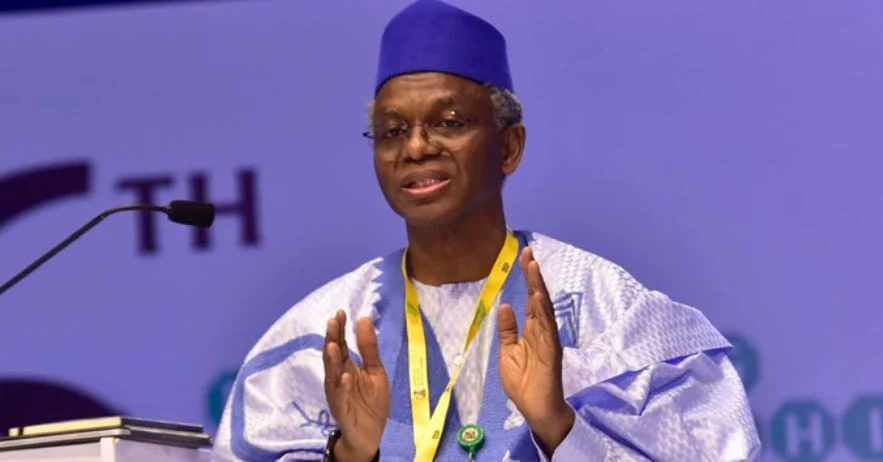

Former Kaduna State Governor, , was on Monday night detained by the (EFCC) in Abuja following hours of interrogation over an alleged N432bn corruption probe, as the Federal Government simultaneously filed criminal charges against him over the purported interception of the phone communications of the National Security Adviser.

Multiple senior sources within the anti-graft agency confirmed that El-Rufai arrived at the commission’s Jabi headquarters around 10am in response to an invitation and was extensively questioned over allegations arising from the 2024 report of the Kaduna State House of Assembly, which accused his administration of misappropriating loans, breaching due process in contract awards and leaving the state with a heavy debt burden.
“He is still in our custody and wouldn’t be released today,” a senior official disclosed late Monday, indicating that investigators had progressed beyond preliminary inquiries.
The EFCC spokesperson, Dele Oyewale, confirmed that the former governor honoured the commission’s invitation but declined to provide details on the interrogation or possible next steps.
The interrogation stems from the report of an ad hoc committee constituted in 2024 by the Kaduna State House of Assembly to investigate loans, financial transactions and contract awards undertaken between 2015 and 2023 under El-Rufai’s administration.
Presenting the committee’s findings during plenary last year, its chairman, Henry Zacharia, alleged that most of the loans secured within the eight-year period were not applied to their stated purposes. The Speaker, Yusuf Dahiru Leman, further alleged that about N423bn was siphoned, recommending the investigation and prosecution of the former governor and key cabinet members.
The Assembly subsequently forwarded petitions to the EFCC and the , urging a full-scale probe into alleged abuse of office, contract inflation, diversion of public funds and money laundering.
Beyond the headline figure, the legislative report referenced disputed cash payments and contracts exceeding N155m, alleged diversion of N1.37bn earmarked for a light rail project, and the purported laundering of N64.8m by senior aides.
El-Rufai has consistently denied wrongdoing, describing the probe as politically motivated and maintaining that all loans were duly appropriated and channelled into infrastructure, education, healthcare and security reforms.
In a parallel development, the Federal Government filed a three-count charge against El-Rufai before the Federal High Court in Abuja over alleged unlawful interception of the communications of the National Security Adviser, .
The charge, marked FHC/ABJ/CR/99/2026 and filed under the Cybercrimes (Prohibition, Prevention, etc.) Amendment Act, 2024 and the Nigerian Communications Act, 2003, followed comments made by El-Rufai during a February 13 appearance on ’s Prime Time programme, where he claimed that he became aware of an alleged plan to arrest him after listening to a call purportedly made by the NSA.
In one of the counts, the prosecution alleged that the former governor admitted that he and unnamed associates unlawfully intercepted Ribadu’s communications, an offence punishable under the Cybercrimes Act. Another count accused him of failing to report knowledge of illegal interception, while a third alleged the use of technical systems compromising public safety and national security. No arraignment date had been fixed as of press time.
Presidential spokesman Bayo Onanuga accused the former governor of attempting to heighten political tension and divert attention from corruption allegations, insisting that the matter would be handled strictly within the bounds of the law.
Adding to the mounting pressure, the has reportedly reopened investigations into the 2019 disappearance of Abubakar Idris, popularly known as Dadiyata, a lecturer at the Federal University Dutsinma who was declared missing in August 2019.
Security sources disclosed that the DSS had seized El-Rufai’s passport at the Nnamdi Azikiwe International Airport, Abuja, to prevent his travel while investigations continue. Investigators are also said to be examining social media posts by his sons in relation to the disappearance.
El-Rufai has repeatedly denied any knowledge of or involvement in the case.
The developments triggered protests in Abuja and Kaduna. In Abuja, demonstrators under the aegis of the Mega National Movement for Good Governance gathered outside the EFCC headquarters, demanding accountability and urging the commission to pursue the matter to its logical conclusion. Supporters of the former governor also assembled nearby, describing the probe as persecution.
In Kaduna, civil society groups stormed the State House of Assembly demanding updates on the legislative investigation. Speaker Leman assured protesters that the House stood by its findings and that “nobody is above the law.”
A coalition of terror victims in Kaduna, represented by human rights advocate Professor Chidi Odinkalu, also issued a statement demanding accountability for alleged human rights abuses during El-Rufai’s tenure.
Opposition figures offered divergent views. The New Nigeria People’s Party and the Labour Party questioned the timing of the charges, suggesting due process must be strictly observed, while maintaining that allegations of such magnitude warrant transparent judicial scrutiny.
Amid the controversy, President publicly praised Ribadu during a visit to Adamawa State, describing him as “honest, bold, courageous and committed,” and expressing confidence in his leadership in the fight against insecurity.
The unfolding confrontation represents one of the most consequential legal and political crises involving a former governor in recent years. Once a central figure in national policy debates and a former Minister of the Federal Capital Territory, El-Rufai now faces simultaneous scrutiny over alleged financial impropriety, cybercrime and a reopened disappearance case.
Whether the developments ultimately constitute lawful prosecution grounded in evidence or political persecution, as his allies contend, will be determined in court. For now, the former governor remains in EFCC custody, his political future uncertain as the nation edges closer to another election cycle.