
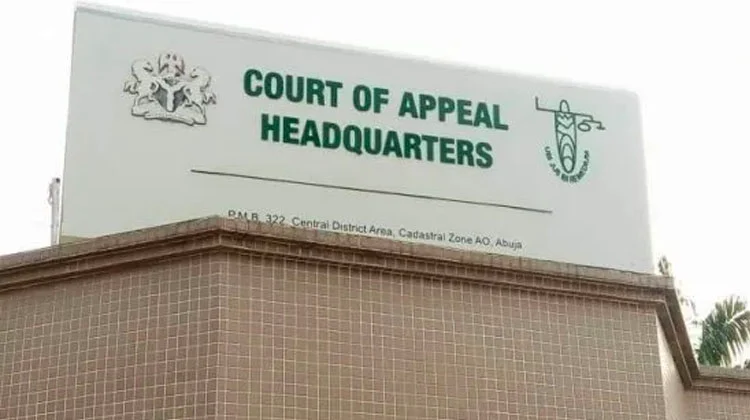

The Court of Appeal, Abuja Division, on Tuesday moved decisively to streamline proceedings in the protracted leadership crisis rocking the Peoples Democratic Party (PDP), ordering parties in the dispute to adopt harmonised briefs ahead of a substantive judgment.
The directive, issued by a three-member panel of the appellate court during a sitting in Abuja, is widely seen as a critical procedural step toward resolving the deep-seated wrangling that has polarised the former ruling party into rival factions since the 2023 general election.
At Thursday’s scheduled sitting, the court is expected to formally adopt the harmonised briefs of argument filed by the contending camps, after which a date for judgment will be fixed.
The courtroom was filled with key stakeholders of the opposition party, including the governors-backed National Chairman, Tanimu Turaki (SAN), and members of the National Working Committee (NWC). Among those sighted were Governors Bala Mohammed of Bauchi State and Seyi Makinde of Oyo State, alongside several other party chieftains.
The Turaki-led faction is seeking judicial affirmation of its legitimacy following a Federal High Court judgment in Ibadan, Oyo State, which nullified the November 2025 national convention that produced the current NWC.
That convention, held amid intense controversy, has remained the flashpoint of the leadership crisis tearing through the PDP’s national structure.
The appellate court is confronted with appeals arising from three conflicting judgments delivered by different divisions of the Federal High Court.
Two of the rulings were handed down by Justices Peter Lifu and James Omotosho of the Abuja Division. In those decisions, the court barred the Turaki-led faction from proceeding with the party’s national convention in Ibadan, citing violations of extant party guidelines and subsisting court orders.
However, in a separate judgment delivered after the convention had taken place, Justice Uche of the Ibadan Division went further to nullify the exercise entirely. The court declared the convention invalid and restrained officials elected at the gathering from parading themselves as national officers of the PDP.
The conflicting pronouncements deepened confusion within the party, with rival groups laying claim to the national secretariat and asserting competing mandates.
To prevent further judicial contradictions and ensure procedural coherence, the Court of Appeal directed the Turaki faction to regularise and harmonise its appeals against the three judgments. The panel also ordered all parties to align their processes to facilitate a unified hearing.
Legal observers say the harmonisation process is intended to eliminate duplications and technical inconsistencies that could otherwise delay judgment or produce fresh procedural disputes.
By adopting consolidated briefs, the appellate court aims to clear the path for a definitive pronouncement on the validity of the convention and, by extension, the authenticity of the party’s national leadership.
While the Turaki-led group maintains that it represents the authentic leadership of the PDP, a rival camp loyal to the Minister of the Federal Capital Territory, Nyesom Wike, has persistently challenged its legitimacy.
The leadership crisis traces its roots to the aftermath of the PDP’s defeat in the 2023 presidential election, which exposed deep fissures within the party’s hierarchy. Disagreements over zoning arrangements, the influence of governors in party affairs, and control of the national secretariat gradually escalated into open confrontation.
Wike’s open support for President Bola Tinubu of the All Progressives Congress during the presidential election further strained internal cohesion, with loyalists on both sides engaging in suspensions, parallel meetings, and prolonged court battles.
Repeated reconciliation efforts by the PDP’s Board of Trustees and other senior stakeholders have failed to yield lasting peace, as factions opted to seek judicial validation of their positions.
The outcome of the appeal is expected to have far-reaching implications for the PDP’s internal balance of power, particularly as it prepares for upcoming off-cycle governorship elections and the 2027 general election.
A ruling in favour of the Turaki-led NWC could consolidate the influence of PDP governors and re-establish a semblance of administrative stability. Conversely, a judgment affirming the nullification of the convention may compel the party to conduct a fresh national convention, potentially reshuffling its leadership architecture.
Political analysts warn that prolonged litigation risks further weakening the party’s cohesion and electoral prospects, especially at a time when opposition unity is increasingly viewed as critical to mounting a credible challenge in future national contests.
For now, attention is firmly fixed on the Court of Appeal, whose impending judgment could mark a turning point in one of the most consequential internal crises in the PDP’s history.