
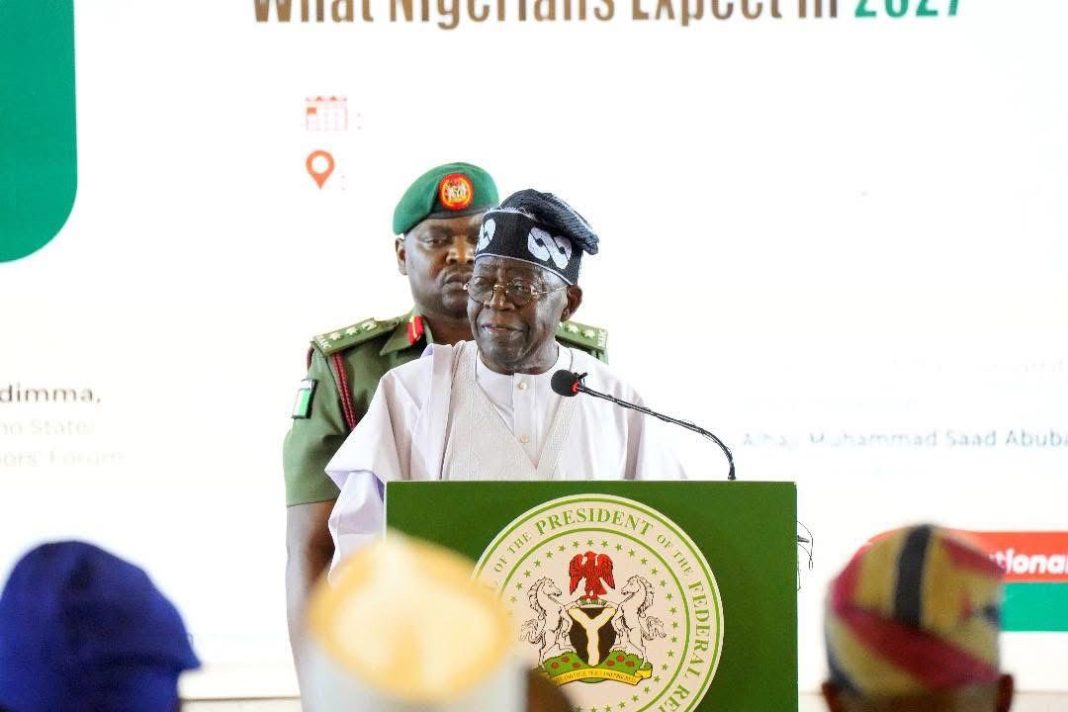

President Bola Ahmed Tinubu, GCFR, on Friday, December 19, 2025, presented the 2026 Appropriation Bill to a joint session of the National Assembly in Abuja, declaring the proposed fiscal plan a decisive step in consolidating Nigeria’s economic reforms and steering the country toward renewed resilience and shared prosperity.
The budget, titled “Budget of Consolidation, Renewed Resilience and Shared Prosperity,” was described by the President as a defining moment in Nigeria’s reform journey, coming after two and a half years of what he called difficult but necessary structural adjustments aimed at stabilising the economy, rebuilding investor confidence and laying the foundation for inclusive growth.
Addressing the Senate President, the Speaker of the House of Representatives, members of the National Assembly and Nigerians at large, Tinubu said the 2026 Budget was presented in fulfilment of a constitutional obligation, but more importantly, as a statement of national resolve to move from economic survival to sustained growth.
He acknowledged that the reform path adopted by his administration had imposed hardships on families and businesses, disrupted established systems and tested budget execution. However, he assured Nigerians that the sacrifices were not in vain, stressing that reform, though painful, remains the surest route to long-term stability and shared prosperity.
According to the President, the 2026 Budget seeks to lock in macroeconomic stability, deepen competitiveness and ensure that economic growth translates into decent jobs, rising incomes and improved quality of life for citizens across the federation.
Highlighting recent economic gains, Tinubu disclosed that Nigeria’s economy grew by 3.98 per cent in the third quarter of 2025, up from 3.86 per cent in the corresponding period of 2024. He also announced that inflation had moderated for eight consecutive months, with headline inflation declining to 14.45 per cent in November 2025 from 24.23 per cent in March 2025, attributing the improvement to stabilising food and energy prices, tighter monetary conditions and improving supply responses.
The President further reported improvements in oil production due to enhanced security, technology deployment and sector reforms, alongside significant expansion in non-oil revenues through improved tax administration. He noted that investor confidence was returning, as reflected in increased capital inflows, renewed project financing and stronger private sector participation.
Tinubu revealed that Nigeria’s external reserves had risen to a seven-year high of about 47 billion dollars, providing over ten months of import cover and a stronger buffer against external shocks. He emphasised that these outcomes were the result of deliberate policy choices rather than chance, and pledged to deepen the gains in pursuit of inclusive prosperity.
Reviewing the implementation of the 2025 Budget, the President disclosed that as of the third quarter of the year, government revenue stood at N18.6 trillion, representing 61 per cent of the target, while expenditure amounted to N24.66 trillion, or 60 per cent of the target. He explained that the extension of the 2024 capital budget execution to December 2025 necessitated a focus on completing priority projects, which affected capital releases under the 2025 budget.
Assuring lawmakers of improved fiscal discipline, Tinubu said 2026 would be a year of stricter budget implementation. He disclosed that directives had been issued to key fiscal authorities to ensure that the 2026 Budget is executed strictly in line with approved details and timelines.
The President outlined four core objectives guiding the 2026 Budget: consolidating macroeconomic stability, improving the business and investment environment, promoting job-rich growth and poverty reduction, and strengthening human capital development while protecting the vulnerable.
Presenting the key fiscal aggregates, Tinubu said the Federal Government expects total revenue of N34.33 trillion, while total expenditure is projected at N58.18 trillion, including N15.52 trillion for debt servicing. Recurrent non-debt expenditure is estimated at N15.25 trillion, while capital expenditure stands at N26.08 trillion. The budget deficit of N23.85 trillion represents 4.28 per cent of Gross Domestic Product (GDP).
He stressed that the figures reflect national priorities and the administration’s commitment to fiscal sustainability, debt transparency and value-for-money spending. The budget is anchored on the 2026–2028 Medium-Term Expenditure Framework, based on a conservative oil benchmark of 64.85 dollars per barrel, oil production of 1.84 million barrels per day, and an exchange rate of N1,400 to the US dollar.
On sectoral allocations, the President announced N5.41 trillion for defence and security, N3.56 trillion for infrastructure, N3.52 trillion for education and N2.48 trillion for health, describing the allocations as interlinked pillars of national renewal.
He reaffirmed his administration’s commitment to national security, announcing enhanced investments in military modernisation, intelligence-led policing, border security and community-based peacebuilding. Tinubu also declared a tougher stance against terrorism, banditry, kidnapping and other violent crimes, unveiling plans for a new national counterterrorism doctrine anchored on unified command, intelligence gathering and community stability.
In the area of human capital development, the President highlighted expanded access to tertiary education through the Nigerian Education Loan Fund, which has supported over 788,000 students in partnership with 229 institutions nationwide. He added that healthcare investment accounts for six per cent of the total budget size, net of liabilities, and disclosed that recent engagements with the United States government had opened access to over 500 million dollars for health interventions.
On infrastructure and economic productivity, Tinubu said the budget prioritises transport and energy projects, port modernisation, agricultural reforms and measures to unlock private capital. He reaffirmed food security as a national priority, with emphasis on mechanisation, irrigation, storage, processing and agro-value chains. He added that the Bank of Agriculture plans to support the cultivation of one million hectares in 2026, create hundreds of thousands of jobs and expand agricultural exports.
The President also outlined procurement reforms introduced since November 2024, which he said have improved efficiency, reduced processing times and generated significant cost savings. He highlighted the Nigeria First Policy, which mandates Ministries, Departments and Agencies to prioritise Nigerian-made goods and local companies in public procurement, aimed at boosting domestic industries, job creation and economic self-reliance.
Tinubu concluded by stressing that the true measure of any budget lies in its delivery rather than its announcement. He pledged better revenue mobilisation, better spending focused on impactful and measurable projects, and stronger accountability through enhanced procurement discipline and monitoring.
Describing the 2026 Budget as one of action rather than promises, the President called on the National Assembly to partner with the Executive in charting Nigeria’s fiscal course for the coming year. He expressed gratitude to Nigerians for their resilience and assured them that the benefits of reform would increasingly reach households and communities nationwide.
“With unity of purpose between the Executive and the Legislature, and with the resilience of the Nigerian people,” Tinubu said, “we will deliver the full promise of the Renewed Hope Agenda.”
He then formally laid the 2026 Appropriation Bill before the National Assembly, seeking legislative consideration and approval.