
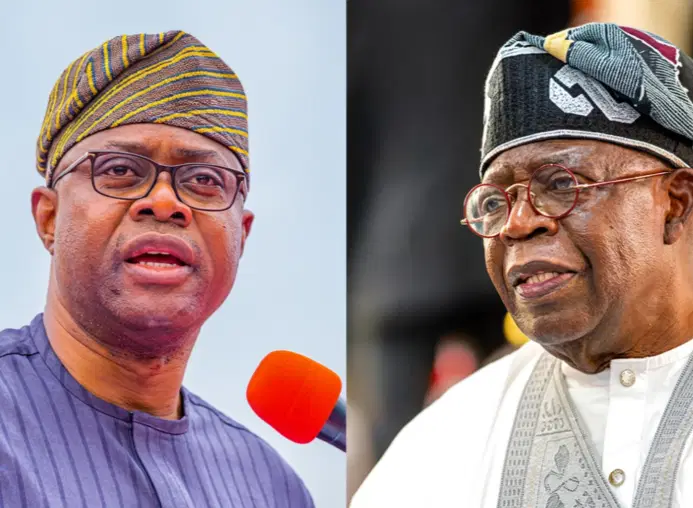

The Allied Peoples’ Movement (APM) has launched a strong political response to President Bola Ahmed Tinubu following his remarks at the All Progressives Congress (APC) presidential campaign rally in Ibadan, declaring that Nigerians are yearning for better living conditions, economic prosperity and responsible leadership rather than presidential name-calling and political theatrics.
The opposition party, in a statement that sharply challenged the President’s political rhetoric, described his apparent reference to the APM through the Yoruba expression “Ẹgbẹ́ Palẹmọ” as an unnecessary diversion from the pressing realities of economic hardship, insecurity, unemployment and the deteriorating purchasing power confronting ordinary Nigerians.
The party argued that the President’s appearance at the historic Mapo Hall rally should have provided an opportunity to address the mounting concerns of citizens and present convincing evidence of his administration’s achievements instead of engaging in verbal exchanges with political opponents.
The position was contained in a statement issued on Sunday by Yinka Oladoyinbo, Director of Communication and Spokesperson of the Oyo State APM Campaign Council.
The APM, whose presidential candidate for the 2027 general election is Oyo State Governor, Engr. Seyi Makinde, described the President’s choice of words as politically revealing, particularly at a time when millions of Nigerians are grappling with the consequences of rising living costs and economic uncertainty.
Explaining the Yoruba expression “Palẹmọ,” the party noted that it carries connotations of hurried packing, gathering belongings and clearing away possessions, sometimes suggesting preparations for departure.
It consequently turned the President’s expression into a subject of political scrutiny, suggesting that the language deserved reflection within the context of the country’s prevailing economic and political circumstances.
The party further invoked the popular proverb that when someone points an accusing finger at another person, four fingers point back at the accuser, arguing that the President should be more concerned about the performance of his administration than attempting to ridicule opposition parties.
In a pointed assessment of the country’s situation, the APM maintained that Nigerians are not looking for political entertainment but concrete answers to questions surrounding the cost of food, transportation, healthcare, education, insecurity and unemployment.
It challenged Tinubu to explain how his administration’s policies have translated into improved living standards for ordinary citizens, insisting that campaign slogans and presidential rhetoric cannot replace measurable economic progress.
According to the party, a leader seeking another electoral mandate must be prepared to account for his stewardship, defend his policy choices and demonstrate how his administration has addressed the difficulties confronting the population.
The APM also argued that the President should have used the Mapo Hall platform to acknowledge the hardship experienced by Nigerians, particularly residents of Oyo State, rather than direct political attacks at opposition figures.
It maintained that the credibility of any administration seeking continuity must be established through its record of performance and the actual experiences of the people.
Royal Palaces Are Not Campaign Platforms, APM Warns APC
The APM also raised concerns over what it described as attempts to exploit the visibility and prestige of traditional institutions for partisan political advantage.
Specifically, it warned against interpreting the interactions and ceremonial engagements of the Olubadan of Ibadanland, Oba Rashidi Adewolu Ladoja, and the Soun of Ogbomoso, Oba Ghandi Afolabi Olaoye, at political gatherings as endorsements of the APC or evidence of the political allegiance of their respective communities.
The party insisted that traditional rulers are fathers to all and must remain above partisan divisions, regardless of the political affiliations of those seeking royal audiences.
It stressed that the responsibilities of traditional institutions extend beyond political cycles to include the preservation of cultural heritage, protection of communal interests, promotion of peace and the provision of guidance to successive generations.
According to the APM, royal palaces should remain neutral institutions where supporters of different political parties, undecided citizens and even those dissatisfied with the political establishment can find accommodation and counsel.
The party warned that traditional rulers must not be reduced to political campaign instruments or presented as electoral endorsements for candidates and political parties.
In a direct message to the APC, the APM argued that palace visits, royal handshakes, photographs and ceremonial courtesies cannot manufacture the consent of the electorate.
It emphasised that a royal handshake is not a ballot paper and a palace audience does not translate into electoral authority.
The party maintained that political parties must earn public confidence through credible leadership, effective governance and demonstrable commitment to the welfare of the people rather than relying on the perceived influence of traditional institutions.
Tinubu’s 2027 Ambition Will Face Voters’ Verdict, APM Insists
Turning its attention to the forthcoming political contest, the APM expressed confidence that Oyo State voters would approach the 2027 general election with a clear understanding of the issues affecting their lives.
It described the electorate as politically conscious and increasingly unwilling to accept empty promises, political intimidation or carefully staged displays of influence as substitutes for good governance.
The party argued that voters would ultimately evaluate candidates through their competence, credibility, policy direction, leadership capacity and ability to provide practical solutions to the challenges facing society.
It further questioned the tangible benefits ordinary Nigerians have received from the Tinubu administration since 2023, asking whether the prevailing economic and security realities offer sufficient justification for another four-year mandate.
According to the party, no amount of political grandstanding can erase the experiences of families struggling to afford basic necessities or communities concerned about their security and economic future.
Reinforcing its position with the Yoruba proverb, “Bí ikún lọ́ ní oko, bí pàkúté, ìpàdé d’ọjọ́ ìbò,” the APM suggested that political confidence and apparent dominance would eventually encounter the decisive test of the ballot box.
The party expressed confidence that Oyo voters would make their electoral decisions on January 16, 2027, based on their personal experiences, expectations and assessment of competing political alternatives.
It insisted that presidential influence, political alliances, royal proximity and campaign spectacles cannot supersede the constitutional right of citizens to determine who governs them.
The APM concluded that the country’s political leadership must understand that the most important measure of governance is not the ability to command attention at campaign rallies but the capacity to improve the lives of ordinary people.
It maintained that Nigerians deserve economic relief, improved security, employment opportunities, affordable living conditions and leadership that responds to their everyday concerns.
For the opposition party, the ultimate political question ahead of 2027 remains straightforward: what has governance delivered to the people, and what more can the electorate reasonably expect?
It expressed confidence that the people of Oyo State would distinguish political noise from credible leadership, ceremonial prestige from genuine public acceptance, and campaign promises from the actual dividends of democracy.