
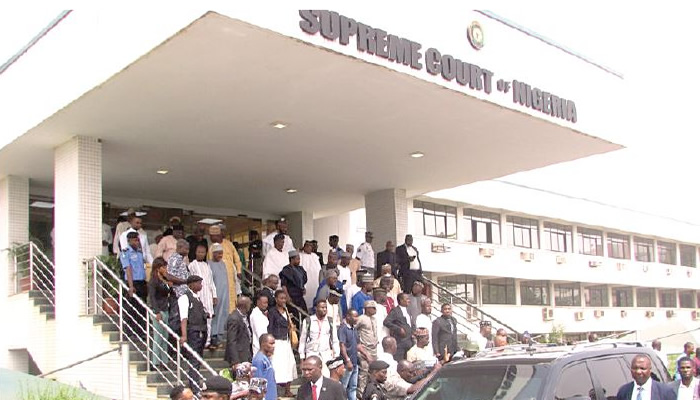

In a decisive and far-reaching judgment with significant implications for Nigeria’s opposition politics, the on Thursday invalidated the National Convention of the (PDP) held in Ibadan, , on November 15 and 16, 2025, citing flagrant violations of subsisting judicial orders.
The ruling marks a critical turning point in the protracted leadership crisis that has engulfed the PDP, delivering a major setback to the faction led by former Minister of Special Duties, , SAN. The apex court upheld earlier concurrent decisions of the and the , both of which had nullified the controversial convention.
Delivering the lead judgment in appeal number SC/CV/164/2026, Justice , speaking for the majority in a split decision by a five-member panel, held that the appeal filed by the Turaki-led faction was devoid of merit. Three of the five justices ruled in favour of dismissing the appeal, emphasizing that the appellants had acted in clear defiance of a valid and subsisting court order.
At the heart of the court’s reasoning was the finding that the faction willfully disobeyed an earlier directive issued by the Federal High Court, which had expressly restrained the conduct of the Ibadan convention pending the determination of related suits. The apex court described the conduct as a “brazen affront to the rule of law,” underscoring that judicial orders must be obeyed unless set aside by a competent court.
In a strongly worded pronouncement, the court further condemned what it termed an “abuse of court process,” noting that the faction improperly procured a conflicting order from a court of coordinate jurisdiction in Ibadan in a bid to circumvent the initial restraining order. This, the court held, amounted to forum shopping and a dangerous precedent that undermines judicial integrity.
Justice Adah affirmed that both the trial court and the appellate court were correct in their reliance on Sections 221, 222, and 229 of the . He reiterated that political parties, though voluntary associations, remain bound by the dictates of the Constitution, electoral laws, and valid judicial pronouncements in the conduct of their internal affairs.
The ruling effectively upholds the March 9 judgment of the Court of Appeal, which not only nullified all proceedings of the convention but also restrained the (INEC) from recognising any officials or decisions emanating from the disputed exercise.
The Supreme Court had reserved judgment on April 22 after hearing extensive submissions from counsel representing the various factions. In its final orders, the court dismissed both the substantive appeal and all cross-appeals, directing each party to bear its own legal costs.
Legal analysts have described the judgment as a watershed moment in the jurisprudence of party politics in Nigeria, reinforcing the supremacy of the rule of law over political expediency. The verdict also closes the door on any further legal challenge by the Turaki faction, effectively extinguishing its claim to legitimacy.
However, the decision leaves the PDP at a critical crossroads, with its leadership structure once again thrown into uncertainty at a time when preparations for the 2027 general elections are gradually gaining momentum. Observers warn that unless swiftly managed, the deepening internal crisis could weaken the party’s cohesion and electoral competitiveness in the years ahead.