


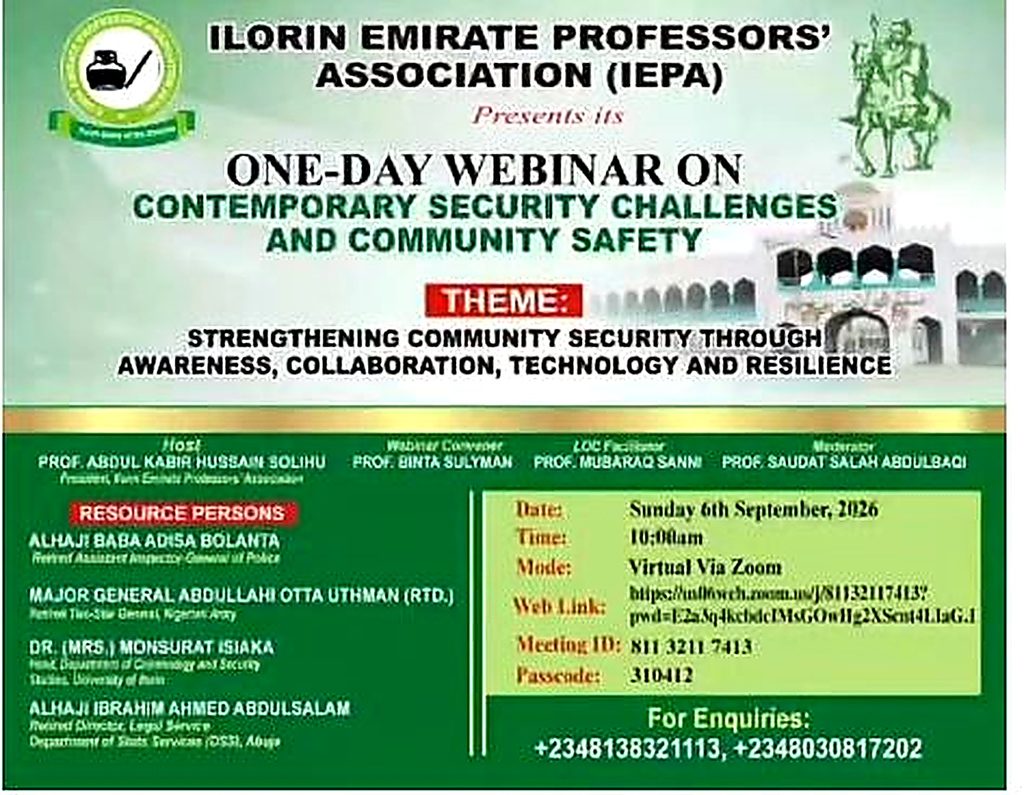
The Ilorin Emirate Professors’ Association (IEPA) on Sunday, 6th September, 2026, held a one-day virtual webinar on “Contemporary Security Challenges and Community Safety,” bringing together retired senior security chiefs, an intelligence expert and a security studies scholar to proffer solutions to rising insecurity in Ilorin Emirate and Nigeria at large.
The webinar, themed “Strengthening Community Security Through Awareness, Collaboration, Technology and Resilience,” was convened by Prof. Binta Sulyman, facilitated by Prof. Mubaraq Sanni, and moderated by Prof. Saudat Salah Abdulbaqi, under the leadership of the association’s president, Prof. Abdul Kabir Hussain Solihu, who served as host.
Four resource persons anchored the discussions: Dr. (Mrs.) Monsurat Isiaka, Head of the Department of Criminology and Security Studies, University of Ilorin; a retired Major General, Abdullahi Otta Uthman; a retired Assistant Inspector General of Police, Alhaji Baba Adisa Bolanta; and a retired Director of Legal Services at the Department of State Services (DSS), Abuja, Alhaji Ibrahim Ahmed Abdulsalam.
Community Policing, Vigilance and the New State Police Law
Presenting on community collaboration, the retired Major General Uthman, urged religious leaders to use their daily sermons and gatherings to sensitise congregants on security, and to reassure would-be informants that their identities would be protected. He called for transparency and equal treatment of citizens by security agencies, warning that inconsistent handling of offenders “creates doubts in the minds of the community.”
He recalled the security jingles once aired by Radio OYO that reminded households nightly to lock their doors, and urged a revival of such sustained public enlightenment campaigns. He also canvassed the creation of joint structures community policing forums, town hall meetings, vigilante groups, neighbourhood watch and area security committees with designated focal points in each community linked to security agencies through dedicated WhatsApp groups, similar to platforms already run by IEPA.
Major General Uthman welcomed the recent passage of the state police law by the National Assembly and its assent by the President, noting that community-based policing would allow officers who live among residents to respond faster to emerging threats. He cited the Ajikobi Central Ward Development Association in Ilorin, an umbrella body coordinating over 20 smaller community associations as a model security agency could plug into for grassroots intelligence.
On collective early-warning measures, he referenced Kwara State Government’s concerns, raised in June 2026, over an influx of unidentified motorcycle (“Okada”) riders into Ilorin, many of whom, he said, are neither indigenes of the emirate nor speak Yoruba. He also flagged itinerant scrap dealers and fruit sellers at road junctions as groups requiring closer community monitoring, and backed calls for biometric registration, identification and uniforms for commercial riders. He further commended joint patrols and curfew enforcement by the Kwara State Road Transport Management Authority, and shared an example from Share town, where youths deliberately sleep during the day so they can stay awake at night to guard their community, a practice he said other towns could adapt. He concluded by calling for stricter arms control, government action on poverty as a root cause of crime, closer intelligence sharing between the DSS and police, and tighter regulation of social media, which he said now freely circulates instructions on harmful and criminal acts.
Technology as a “Force Multiplier,” Not a Substitute for People
The retired AIG, Baba Adisa Bolanta, an Ilorin-born officer who rose through the Nigeria Police Force to command in Sokoto and Imo states and later served as AIG in charge of the Police Academy, Kano, before retiring in 2016 spoke on harnessing technology for community security, surveillance and emergency response.
He described technology as “a critical force multiplier” that supports, rather than replaces, security personnel and community participation, and advocated the establishment of layered community security committees to deploy such tools effectively. He listed the benefits of technology as early warning, situational awareness through CCTV and smart sensors, rapid communication with responders, stronger evidence for prosecutions, and more efficient use of scarce security personnel, illustrating the point with a case, about two months earlier, in which CCTV footage helped secure the conviction of a burglar despite a strong legal defence.
He highlighted digital tools available to communities, including toll-free emergency lines such as Nigeria’s 112 service linking callers to police and fire responders, mobile incident-reporting platforms, crime-mapping software, and mass public-alert systems, drawing a comparison with Israel’s missile early-warning system. On surveillance infrastructure, he discussed CCTV networks tied to monitoring centres, access-control systems using cards or fingerprints, lawfully deployed drones for reconnaissance and disaster assessment, and smart sensors for fire or flood detection, stressing that such tools must be lawful, proportionate, accountable and privacy-respecting.
Bolanta warned of the practical obstacles: the high cost of acquiring and maintaining equipment, unreliable power supply, a shortage of trained technical personnel, cybersecurity threats and data breaches, risks of surveillance abuse, and poor interoperability between the different systems used by police, the DSS, fire services and other responders. He set out guiding principles for responsible use; legality, necessity and proportionality (cautioning against communities acquiring military-grade equipment for civilian purposes), data protection, human oversight of automated systems, accountability, and open communication with communities about both the purpose and limits of the technology deployed. He proposed a practical roadmap beginning with a community security and technology needs assessment, identification of security hotspots, scalable pilot projects, multi-agency coordination through joint operations rooms, citing Kwara’s existing arrangement involving the military, police, DSS, NSCDC, immigration and customs and ongoing training, maintenance and evaluation. “Technology is truly a force multiplier,” he said, “but it is not a substitute for trusted people and institutions.”
Nigeria’s “Polycentric” Insecurity and the Case for Early Warning Systems
The final resource person, Alhaji Ibrahim Ahmed Abdulsalam, a fellow of the National Security Institute and retired DSS Director of Legal Services, spoke on early warning systems and information sharing. He described Nigeria as grappling with a “polycentric security landscape”, insurgency in the North-East, banditry and kidnapping in the North-West, farmer-herder conflict in the North-Central, and secessionist agitation, oil theft and urban crime in the South, arguing that state-centred, reactive policing alone cannot secure a country of Nigeria’s size and porous borders. He called for a shift toward community-led, proactive resilience, grounding his argument in structural-functionalist theory and Robert Putnam’s concept of social capital, distinguishing between “bonding” ties within communities and “bridging” ties such as those between farmers and herders that must be deliberately built through shared communication channels.
He outlined the pillars of an effective, people-centred early warning system: mapping local vulnerabilities and historical triggers of violence; monitoring indicators such as sudden food-price spikes, unusual cattle movements, spikes in pharmacy purchases of certain medications, or the sudden departure of women and children from a village; and disseminating warnings quickly to those at risk — what he termed the “last-mile problem” of bridging high-level intelligence with vulnerable civilians. He attributed weak information flow largely to a deep trust deficit between communities and security agencies, rooted in fear of reprisal and the absence of guaranteed informant anonymity, compounded by fragmented, non-interoperable communication systems among the military, DSS, police, Amotekun and civilian vigilante groups.
To strengthen resilience, he called for the “co-production” of security by formally integrating community actors; local hunters, traditional rulers and religious leaders into security structures; wider use of accessible platforms such as WhatsApp and Telegram for anonymous crowdsourced reporting; and the creation of local government-level “situation rooms” bringing together traditional authorities, youth leaders and security representatives to verify rumours and issue localised alerts without waiting for direction from Abuja or state capitals. He closed with four policy recommendations: a legislative framework guaranteeing anonymity and protection for informants; mandatory interoperable communication protocols linking state forces with recognised community groups; academic-led, participatory research commending IEPA’s webinar as a step in this direction to design localised early warning prototypes; and decentralised, legally backed emergency contingency funds for local governments to support community-led rapid response.
Questions, Concerns and Calls for Follow-Through
The question-and-answer session drew contributions from several participants. A contributor who joined from Zaria via an Ilorin Emirate development platform questioned the relatively low attendance at the webinar and asked how its outcomes would reach the wider community in the absence of press coverage. He also faulted weak consequences for high-profile criminal suspects, referencing the cases of notorious kidnap figures Evans and Wadume, alleged illegal gold mining in Kwara State, and called on academics to take a more active role in the electoral process to improve leadership selection. The moderator assured him the session was being recorded and that IEPA has an in-house mechanism for disseminating outcomes to the grassroots.
Another participant raised the pervasive erosion of public trust and confidence in the military, police and other security agencies, asking how that trust could be rebuilt. A commander with the National Drug Law Enforcement Agency (NDLEA), Lafiagi Zonal Command, linked weak law enforcement and lenient sentencing to the persistence of crime, argued for a firmer legal deterrent against drug offenders, disclosed that NDLEA offers a drug-integrity test through which parents can check whether their children are using drugs, and suggested that a future IEPA webinar focus specifically on drug abuse. A further contributor pointed to unemployment as one of several underlying, multifactorial drivers of insecurity that must also be addressed.
Among those who took the floor during the interactive session was Engineer Ayinde, who raised the questions on attendance, dissemination of the webinar’s outcomes, and the Evans and Wadume cases. A participant identified as Mr. Nurudeen also contributed, pressing the resource persons on how to rebuild public trust in security agencies. A Lafiagi Zonal Command commander of the National Drug Law Enforcement Agency (NDLEA) spoke at length on law enforcement, sentencing and drug abuse, while Professor Oniye closed out the discussion segment with a vote of appreciation to the organisers and resource persons.