
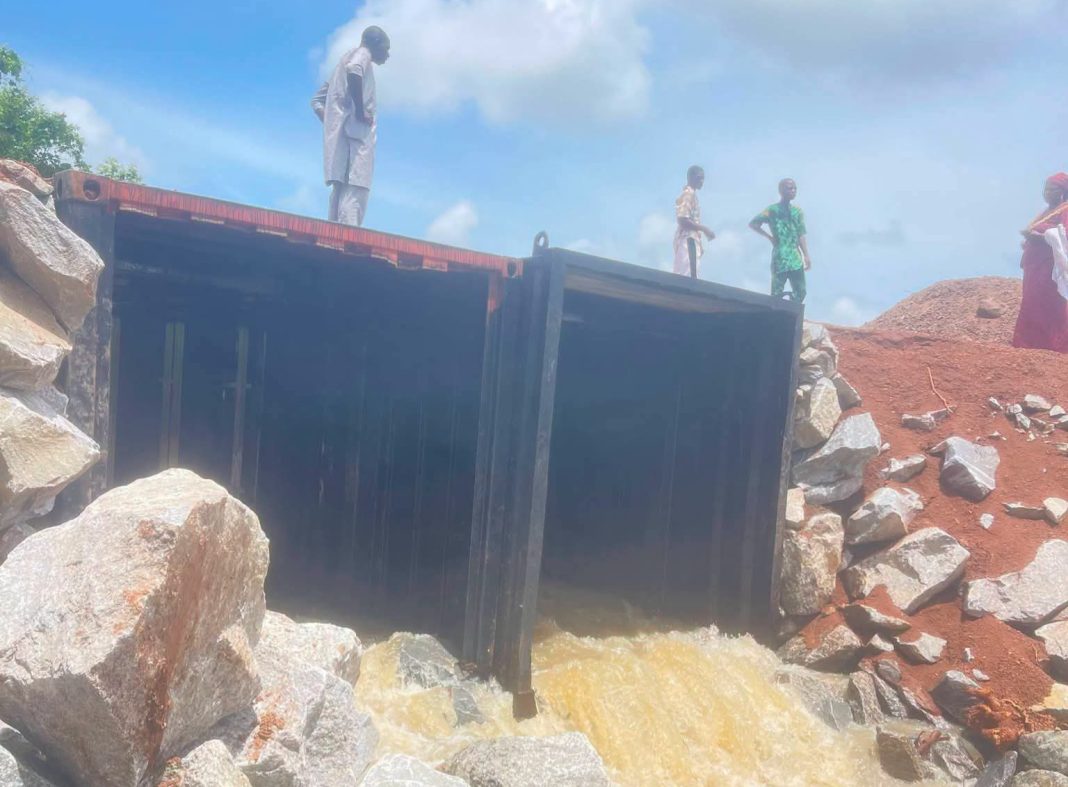

Residents of Moro Local Government Area and adjoining communities in Kwara State have voiced growing dissatisfaction over the continued use of a container bridge serving as a temporary crossing point, criticizing Governor for what they describe as an inadequate response to one of the state’s critical infrastructure challenges.
The controversy has intensified following the circulation of photographs showing a makeshift bridge constructed with shipping containers reinforced by rocks, while muddy floodwaters flow beneath the structure. The images have triggered widespread debate across the affected communities, with residents questioning the safety, durability, and suitability of the temporary arrangement for a route relied upon daily by thousands of commuters, farmers, traders, students, commercial transport operators, and other road users.
Community members argue that the bridge falls far short of acceptable engineering standards expected of public infrastructure and have expressed concern that the temporary structure may not withstand the increasing pressure of heavy vehicular movement, particularly during the peak of the rainy season when floodwaters are known to rise significantly.
According to residents, the continued reliance on what they describe as a palliative intervention reflects a broader failure to provide lasting infrastructure capable of supporting the economic and social needs of the region. They insist that Kwara State deserves professionally designed and permanently constructed bridges that guarantee the safety of lives, facilitate commerce, and promote sustainable development rather than emergency structures whose long-term stability remains uncertain.
Several residents lamented that the condition of the crossing has continued to disrupt commercial activities across the area. Farmers reportedly face increasing difficulties transporting agricultural produce to urban markets, while traders incur additional transportation expenses due to delays and reduced accessibility. Motorists also express anxiety over crossing the structure, especially during periods of heavy rainfall when fears of erosion and flooding become more pronounced.
Beyond transportation challenges, residents warn that the situation has broader economic implications for communities that depend heavily on uninterrupted road connectivity. They argue that poor infrastructure discourages investment, slows business activities, affects school attendance, and limits access to healthcare and other essential public services.
The latest public outcry comes amid sustained concerns over transport disruptions along the Moro bridge corridor. Transport unions and stakeholders have previously appealed for urgent intervention, warning that deteriorating bridge infrastructure continues to impede movement, weaken commercial activities, and negatively affect livelihoods across several communities within the state.
Many residents maintain that temporary palliative measures can no longer substitute for comprehensive infrastructure development. They are calling on both the Federal Government and the Kwara State Government to expedite the construction of a permanent bridge built to modern engineering specifications, while ensuring transparency, accountability, and timely completion of the project.
They further contend that communities making significant contributions to Kwara State’s agricultural production and economic development deserve infrastructure capable of serving current demands as well as future population and economic growth.
While the Kwara State Government has maintained that its intervention on the damaged crossing has been limited to temporary palliative measures pending the execution of a permanent bridge project reportedly under federal supervision, residents insist that the pace of work remains unsatisfactory and are demanding accelerated construction to prevent further hardship.
For many people in Moro and neighboring communities, the debate has evolved beyond the condition of a single bridge. They describe it as a fundamental issue of public safety, economic survival, and responsible governance, emphasizing that access to safe and durable infrastructure remains one of government’s most essential obligations.
As pressure continues to mount, residents hope that their repeated appeals will prompt swift action from the relevant authorities, averting potential disasters while restoring public confidence in infrastructure development across the state.