
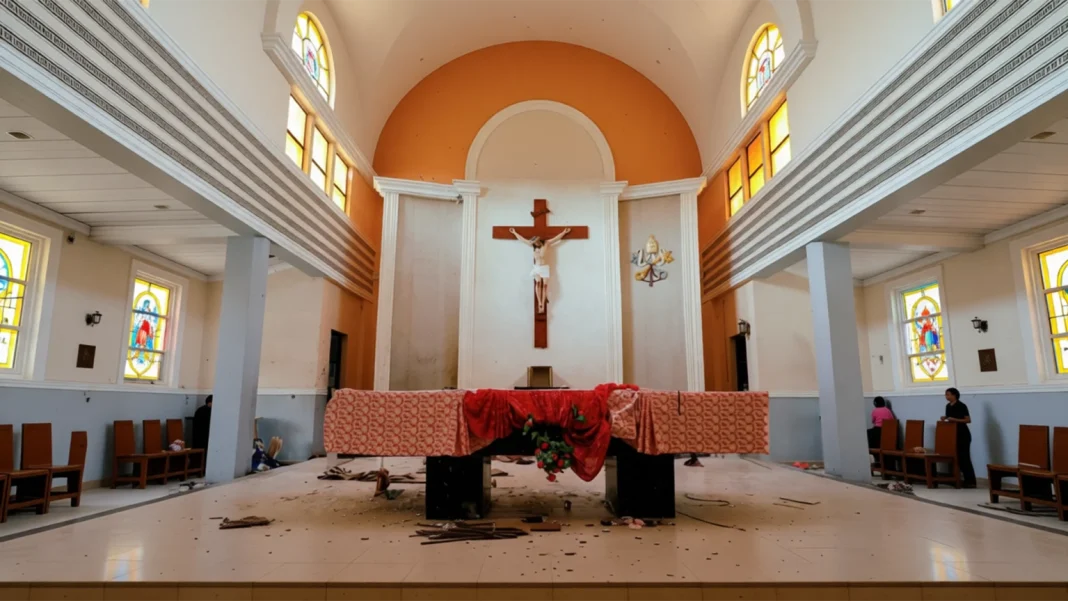

The Federal High Court sitting in Abuja has sentenced four terrorists to death by hanging for their involvement in the gruesome attack on Saint Francis Catholic Church, Owo, Ondo State, which claimed the lives of 43 worshippers and left several others injured in one of Nigeria’s most shocking acts of terrorism against a place of worship.
Justice Emeka Nwite delivered the landmark judgment on Wednesday, finding four of the five defendants guilty on all nine counts brought against them by the Federal Government. The court ordered that the convicts be hanged until they are confirmed dead, bringing to a close a high-profile trial that has attracted national and international attention since the deadly attack occurred.
The convicted terrorists were identified as Idris Abdulmalik Omeiza, 25; Al Qasim Idris, 20; Jamiu Abdulmalik, 26; and Abdulhaleem Idris, 25. However, the fifth defendant, Momoh Otuho Abubakar, 47, was discharged and acquitted after the court found insufficient evidence linking him to the charges filed against the accused persons.
The judgment represents a significant milestone in Nigeria’s efforts to ensure accountability for acts of terrorism and violent extremism. The prosecution had presented evidence linking the convicts to the June 5, 2022 attack on Saint Francis Catholic Church in Owo, where gunmen invaded the church during Sunday Mass and opened fire on worshippers. The attackers also reportedly detonated explosives, causing widespread panic and devastation among congregants.
The massacre sent shockwaves across Nigeria and beyond, drawing condemnation from religious leaders, civil society organisations, foreign governments and international human rights groups. The attack was widely regarded as one of the deadliest assaults on a Christian place of worship in recent Nigerian history, reigniting concerns about insecurity and terrorism across various parts of the country.
During the trial, prosecutors argued that the defendants played direct and active roles in planning and executing the attack. They were charged with terrorism-related offences, conspiracy, murder and other criminal acts under Nigeria’s anti-terrorism laws. The court, after reviewing the evidence and testimonies presented before it, concluded that the prosecution had successfully proved its case beyond reasonable doubt against the four convicted persons.
In delivering the judgment, Justice Nwite held that the gravity of the offences and the loss of innocent lives warranted the maximum punishment prescribed by law. The ruling underscores the judiciary’s commitment to supporting national efforts aimed at combating terrorism and ensuring justice for victims of violent crimes.
The verdict has been welcomed by many stakeholders, particularly families of the victims and residents of Owo, who have waited years for justice following the tragic incident. The judgment is also expected to provide some measure of closure to the Catholic community and the families of those who lost loved ones in the attack.
Meanwhile, reactions have continued to trail the court’s decision, with security experts describing the ruling as a strong message to terrorist groups operating within and outside Nigeria. Observers note that while the judgment cannot reverse the pain and losses suffered by the victims’ families, it reinforces the principle that perpetrators of terrorism will be held accountable under the law.
As the nation reflects on the tragic events that unfolded at Saint Francis Catholic Church, Owo, the judgment stands as a significant chapter in the pursuit of justice, accountability and the broader fight against terrorism in Nigeria.