


An unverified claim that a radio newsroom told staff to shrink casualty figures has been seen 700,000 times on X. It cannot yet be proved, but the reaction shows how thin the public trust in broadcasters has become.
Nigerians have a long habit of turning grief into arithmetic. In a country whose last national census was in 2006, numbers have always been a contested property. How many voted, how many were counted, how many lived in a town, how many died in a fire: every figure arrives with an argument attached. So when a stranger on X, which most Nigerians still call Twitter, announced last Saturday that a radio newsroom once told him to turn seventy-six dead into seven, the country did what it does best. It believed him first and asked questions later.
On Saturday, 26 September, a user known as @alphacruiz posted three short lines. Here they are, just as he typed them:
when I dey work for radio as ‘journalist’
76 people go die for Abuja them go say make we talk say na 7.
make una thank God for twitter news sha.
In plain English, he was saying: When I was working in radio as a “journalist”, 76 people would die in Abuja and they would tell us to say it was 7. Thank God for Twitter news, all the same.
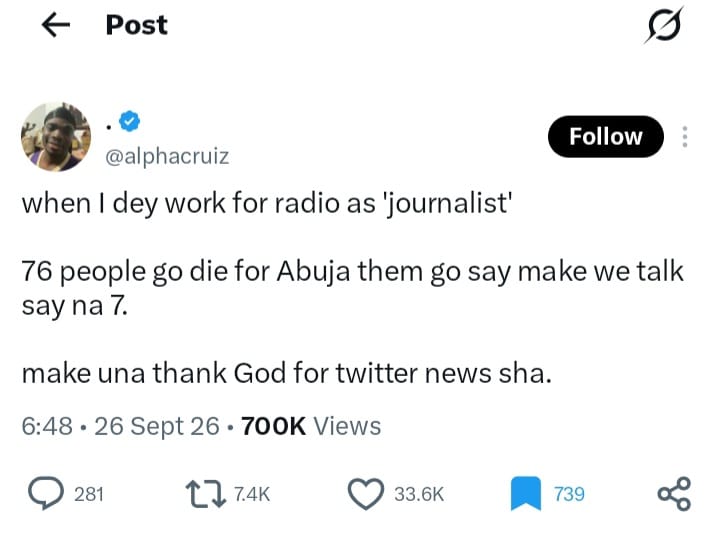
The post by @alphacruiz on X, dated 26 September 2026, saying that when he worked in radio, 76 people would die in Abuja and staff would be told to say seven. Screenshot taken on 28 September 2026 at 6:45pm. The claim is unverified.
It was a claim about broadcasters, made on a platform built to replace them. When I checked, the post had been seen about 700,000 times, liked 33,600 times and reposted 7,400 times.
Consider what the post does not say. It names no radio station. It names no incident, no year and no editor, manager or official who gave the instruction. The poster put the word journalist in quotation marks, which leaves open whether he was a reporter, a presenter or something else. His account carries a blue tick, but on X that mark is bought with a subscription. It tells us he pays, and nothing more about where he worked.
It would be easy to stop there and call the whole thing an unproven rumour. It would also be a mistake, because the unproven claim is not the most interesting part of the story. The reaction is.
I read the replies closely. Not one of them offered a second account from inside a newsroom that could be checked. A user who said he, too, once worked at a radio station wrote “omoh everythin’ nah lie”, but named no station and no incident. Another said he had spoken to people in Benue during his National Youth Service year and found the post credible, which is a kind of conversation, not evidence. A third said radio reporters have no power and simply follow instructions. These are opinions, sincerely held, and they reveal a great deal about the mood of the audience. They do not establish a single fact about the newsroom in question.
One reader pushed back, and he deserves a hearing. A man who gave his name as Abiodun Sanusi, and whose account could not be independently confirmed, wrote that he spent most of his career as a crime reporter, mainly in Abuja, and was never once made to underreport a death toll. He called the claim a very big lie and asked which station, and who “they” were. What struck me more was how many people did not doubt the practice at all and merely argued about its motive. One said the aim was to prevent panic, another that it was to protect international investors, a third said that lower numbers spare the living from further harm. Very few asked whether it had happened. A public that debates the reason for an alleged deception, before asking whether the deception occurred, has already reached a verdict, and the verdict is against the microphone.
Has there ever been a case in Abuja that lets us test such a suspicion? There is at least one that readers themselves raised. On 14 April 2014, a bomb went off at the Nyanya motor park, on the outskirts of the capital, during the morning rush. The police spokesman put the dead at 71 and the wounded at 124. The following hours and days told a more restless story. Premium Times ran a headline saying over 200 were feared dead. Vanguard’s headline the next day read “100 perish in motor park bombing.” Its report put the dead at no less than 88, printed the police spokesman’s figure of 71 beside it, and said eyewitnesses and hospital sources believed the true number was higher. The Punch reported 89. Later accounts settled at 75, and some summaries put it at 88 or more.
A reader on the same thread claimed that more than 300 died at Nyanya and more than 500 were injured. I found nothing to support either figure. What the record does show is different and, in its way, more instructive. The early numbers in print were higher than the official one, and then the official one crept upward. That is a gap, but it is a gap between fear and confirmation, and it began with police and emergency agencies, not with a radio desk. Whatever Abuja radio stations told their listeners in 2014, the public record does not currently show it, and that silence is itself a problem for anyone who wants to settle the matter.
This does not mean the poster is wrong. It means the claim is untested, and honesty requires us to say so in the same breath as we say why it travelled.
It travelled, I think, because the last few weeks gave Nigerians fresh cause. On 17 September, 37 detainees were found dead in the custody of the Nigeria Security and Civil Defence Corps in Minna, Niger State. The agency initially suggested a disease outbreak, while the cause of death remained under investigation. The Federal Government later constituted an independent committee to investigate the deaths, and the Niger State commandant was suspended. Survivors and reports from the scene raised allegations of overcrowding and poor ventilation, while authorities said the cause had not been established. Earlier this month, a local group said 37 people died after inhaling fumes in a pipeline theft in the Niger Delta, while the Civil Defence Corps said it had recovered four bodies and the company concerned called the claim “blatant lies”. Last year, the Benue State government put the dead of the Yelewata attack at 59, while other reports put the toll above 100.
Notice who is disputing whom in each of these cases. It is officials, agencies and companies on one side, and communities, groups and eyewitnesses on the other. In none of them does the evidence point to a newsroom receiving orders to shrink a figure. A radio station that repeats a police number has not lied, it has quoted. The trouble starts when the quote is all the listener ever hears, and when the listener has learned, from bitter experience, to multiply whatever they are told by ten.
That is where X enters, both as rescuer and as risk. Many replies thanked the platform for telling them what the airwaves would not. One reader remarked, sensibly, that even there, plenty of fake news and agenda are flying about. He is right. The same platform that carried the news of the miners in Minna carried a claim about an unnamed newsroom to 700,000 screens without anyone having to show a single document. It has no editor, no owner to please and no one to answer to, which is its freedom and its danger.
No station or union is accused in the post, since the poster named none. What the public record does offer is the standard any newsroom would be measured against. The Code of Ethics for Nigerian Journalists tells reporters to refrain from publishing inaccurate and misleading information, and says decisions about the content of news belong to a professional. A recent academic study of Nigerian broadcasters found that most stations uphold truthfulness and factual accuracy, but slip on fairness, balance, sponsorship disclosure and editorial independence, and it traced those lapses to political influence and financial dependency, not ignorance of the code. Regulator and union are also at odds. In April 2026, the National Broadcasting Commission (NBC) said it had seen a sustained rise in breaches of the Broadcasting Code in news and political programmes, and the Nigeria Union of Journalists (NUJ) called the warning “a veiled attempt to gag the media”. Neither body has commented on the claim in this article.
The poster himself supplied the standard by which all of this should be judged. A journalist, he wrote, swears to tell the public the whole truth and never to misinform. That oath binds the man who accuses as surely as the one who reports. If the claim is true, then it deserves a station’s name, an incident and a witness, so that the public can hold someone to account. If it is false, then a great many people have been persuaded of it by nothing more than a feeling that had been waiting for a voice.
The distance between seven and seventy-six is not arithmetic. It is trust, and trust in this country has been spent down to a point where a man can say almost anything about the press and find a crowd ready to nod. Newsrooms should take no comfort in that. Neither should the crowd.