
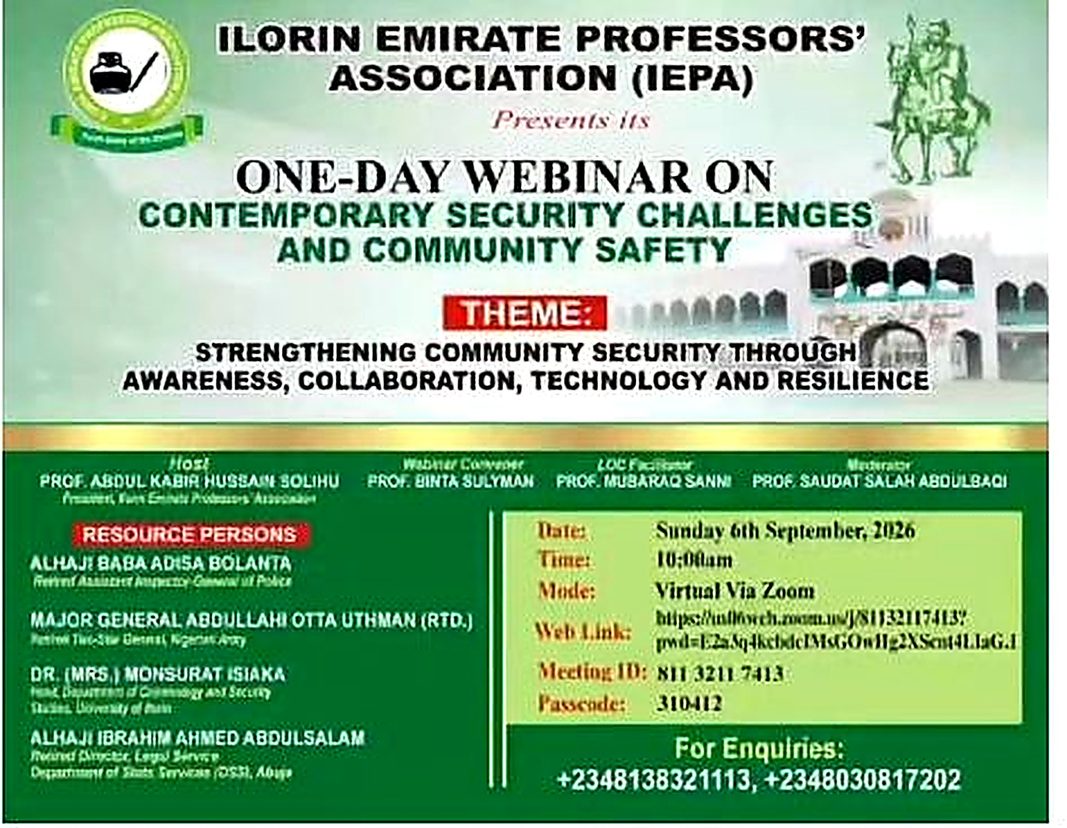

A one-day webinar by the Ilorin Emirate Professors’ Association asked a critical question: what if safety began not with the gun or the garrison, but with the neighbour, the imam, the community group and the informal WhatsApp network?
By Isiaka Zubair Aliagan
Before the Sunday sun climbed high on 6th September, 2026, an unusual gathering assembled, not in a hall of polished floors and rows of chairs, but across the glowing rectangles of laptops and telephones. Professors, retired generals, a former police chief, a veteran of the intelligence service, serving narcotics officers and ordinary citizens from Ilorin and as far away as Zaria came together in a virtual room to wrestle with the defining anxiety of the age: how does a community keep itself safe?
The One-Day Webinar on Contemporary Security Issues, organised by the Ilorin Emirate Professors’ Association (IEPA), carried a theme that read almost like a creed: “Strengthening Community Security Through Awareness, Collaboration, Technology and Resilience.” It was convened by Prof. Binta Sulyman, facilitated by Prof. Mubaraq Sanni and moderated with warmth and brisk discipline by Prof. Saudat Salah Abdulbaqi. The programme ran under the leadership of the association’s president, Prof. Abdul Kabir Hussain Solihu.
Four resource persons gave their insights at the discussions: Dr. (Mrs.) Monsurat Isiaka, Head of the Department of Criminology and Security Studies, University of Ilorin; retired Major General Abdullahi Otta Uthman; retired Assistant Inspector General of Police Alhaji Baba Adisa Bolanta; and Alhaji Ibrahim Ahmed Abdulsalam, retired Director of Legal Services at the Department of State Services (DSS), Abuja.
A welcome that set the tone
In his opening address, Prof. Solihu told the gathering that security can no longer be left exclusively to governments and formal agencies. The changing nature of threats, he said, demands a whole-of-society approach in which families, traditional institutions, religious bodies, schools, the private sector and the security services pull together. He catalogued the dangers with a scholar’s precision: violent crime, banditry, kidnapping, cybercrime, misinformation, communal tensions and the quiet vulnerability of the young.

He then offered four pillars on which safer communities must stand. Awareness lets citizens recognise risk and know their duty. Collaboration breeds trust and shared action. Technology supplies tools for early warning and rapid response, though it also opens new vulnerabilities that must be managed. Resilience lets a people withstand a blow, recover and adapt without losing their cohesion or confidence.
Prof Solihu added a hope that struck the right note for an association of scholars: that the discussions would move beyond naming problems to practical, sustainable remedies, and that the universities’ “enormous intellectual resources” would be put to work for the common good. The proceedings that followed went some way toward answering that hope.

Awareness: why the soft approach keeps failing the young
The first pillar fell to the academy. Dr. Monsurat Isiaka opened with an uncomfortable fact. Nigeria faces terrorism, banditry, kidnapping, robbery, human trafficking, murder and cybercrime all at once, and kinetic operations, however necessary, cannot alone deliver lasting safety. The state has begun to adopt “soft” doctrines: the Operation Safe Corridor de-radicalisation programme, community policing, and socio-economic interventions through the North-East Development Commission (NEDC). Yet public awareness of these efforts is low, and structured security education is almost non-existent. The result, she argued, is a youth population with little culture of vigilance and little sense of civic responsibility, at the very moment the national security architecture needs both.

She began with the evidence from abroad. Early in the 2000s, the United Kingdom funded grassroots organisations, mental health practitioners and community associations to spot the early markers of radicalisation, and hundreds of vulnerable people were steered into counselling before their beliefs turned violent. Colombia, facing gangs, cartels and guerrillas, moved much of its internal security towards whole-of-society community policing and local conflict-mediation boards. This dissolved the old “us versus them” divide between state and marginalised neighbourhoods and produced ground-level intelligence that let police act without high-casualty military sweeps.
Success has been far harder to find in Sub-Saharan Africa, and she pointed to the Sahel and Lake Chad Basin. In Niger, she said, the National Dialogue Framework and the youth Committees of Vigilance in Diffa and Tillabéri were captured by patron-client politics. Elites controlled the leadership and funding, rewarded favoured militia actors and sidelined ordinary youths. Once young people saw they were being treated as unpaid informants rather than partners, their engagement turned to apathy, a vacuum that ISWAP exploited with paid recruitment. In Chad, soft-power border accords sat inside a repressive state. Soldiers routinely profiled and roughed up border youths during sweeps, so that outreach looked like surveillance. The lesson, she said, is the same in both countries: where security education is not democratised and gatekeepers are not removed, young people retreat into protective apathy and the early-warning networks go dark.
Nigeria, she argued, tells the same story. Operation Safe Corridor is inward-looking, focused on rehabilitating repentant fighters rather than educating the host communities that must live beside them. The Civilian Joint Task Force (CJTF) was conceived less to address the roots of terrorism than to borrow local youths’ knowledge of terrain, from the hinterlands to the Sambisa Forest. Neither offered a compelling counter-narrative to extremist ideology, nor healed the trauma left by decades of heavy-handed operations. Socio-economic programmes, including the NEDC, livelihood initiatives and the National Social Safety Nets Project, are dogged by corruption and nepotism that leave intended beneficiaries out. That alienation makes extremist narratives more attractive, she said, and helps explain the slow, reactive response to emerging groups such as Lakurawa. It also helps explain the spread of attacks into the North-Central, where villages across Kwara State, among them Woro, Nuku, Kemanji, Teneba and Baabete in Kaiama, Oro-Ago, Oyale, Ahun and Babanla in Ifelodun, and parts of Patigi and Baruten, have come under threat. If radicalisation and recruitment could be cut off at the source, she asked, how would terrorists survive and spread?
Urban community policing fares little better, she said. In theory it is a bottom-up partnership, but in practice advisory boards are dominated by political godfathers, traditional rulers and senior officials, a pattern of elite gatekeeping that squeezes out artisans, unions and youth leaders who know the threats best. A legacy of profiling and extortion compounds the damage, and the EndSARS protests, led largely by the young, made the cost of that distrust plain.
Collaboration: the pulpit and the prayer mat as instruments of peace
Major General Abdullahi Otta Uthman (rtd) spoke on community collaboration. His central insight was disarmingly simple: if you wish to reach a community, go where the community already gathers.
Every day, he reminded the audience, there is a prayer or ceremony somewhere in the emirate, and imams and malams stand before congregations that trust them. Let those leaders, he urged, use their sermons to explain what security means and what is asked of each believer, and let them assure would-be informants that their names will be guarded. In return, the government must be open about what it is doing to protect its people, and the agencies must treat every citizen alike. “Inconsistent handling of offenders,” he warned, “creates doubts in the minds of the community,” and doubt, once planted, is a hard weed to uproot.
He reached back into memory for an illustration: the jingles on Radio Oyo that reminded households each night to lock their doors before bed. A simple tune, repeated faithfully, had once shaped a whole society’s habits. Why not, he asked, revive that spirit of sustained public enlightenment, using electronic media to unite rather than divide? His point echoed the awareness gap Dr. Monsurat Isiaka had just described.
His practical architecture was generous in scope: community policing forums, town hall meetings, vigilante groups, neighbourhood watches and area security committees. Each community, he proposed, should name focal persons from its association executives to carry information to the security agencies and bring feedback home. Linked on dedicated WhatsApp groups, as many associations already are, these focal points would let a tremor in one quarter be felt at once in the next, so that neighbours could rush to help or bar their own gates in time.
He welcomed the National Assembly’s passage of the state police law and the President’s assent, observing that officers drawn from the community, who live among the people they protect, will be the first to know of trouble and the first to respond. He pointed to the Ajikobi Central Ward Development Association, an umbrella body coordinating more than twenty smaller associations, as a ready channel for grassroots intelligence.
On early warning, he cited the Kwara State Government’s concern, raised in June, over an influx of unidentified commercial motorcyclists into Ilorin, many of them, he observed, neither indigenes nor Yoruba speakers. He called for biometric registration, identification and uniforms for riders, and flagged itinerant scrap dealers and fruit sellers who linger at junctions and vanish without explanation as groups worthy of a watchful eye. He commended joint patrols and curfew enforcement, with exceptions for emergencies, and told of a town where youths sleep through the day so that they may keep vigil through the night. He closed with calls for stricter arms control, action on poverty and hunger as roots of crime, closer intelligence sharing between the DSS and the police, and tighter regulation of social media, where instructions for harm circulate all too freely.
Technology: the machine is only as good as the people behind it
If the General spoke to the heart of the community, retired Assistant Inspector General of Police Alhaji Baba Adisa Bolanta spoke to its toolbox. An Ilorin-born officer who joined the force in 1982, he commanded in Sokoto and Imo, served as Commissioner in charge of Armaments at Force Headquarters, Abuja, and retired in 2016 as AIG. He brought that long career to a pointed theme: technology for community security, from digital surveillance to emergency response.
He began with the dictionary’s own definition: security is a state of being free from fear and apprehension. But it is wider than that, he said, embracing floods and fires as surely as bandits and kidnappers. Since the dawn of democracy in 1999, Nigeria has endured an expanding catalogue of violence, and traditional methods alone no longer suffice. Technology, he argued, is “a critical force multiplier,” but it supports people and never replaces them.
He made the case with a story. About two months earlier, an intruder had broken into a house through the roof. A hidden camera, recording his movements as he rummaged for valuables, caught his face when he paused at a wall. That single image helped police arrest him, and despite a formidable defence lawyer, the evidence was so overwhelming that he was convicted.
The AIG then walked the audience through the modern arsenal of safety: toll-free emergency lines such as 112, mobile reporting platforms, crime-mapping software and mass alert systems, with a comparison to Israel’s early-warning network that tells citizens at once what to do and where to go. He described CCTV networks wired to command centres, card and fingerprint access controls, lawfully deployed drones and smart sensors that detect intrusion, fire and flood.
He was equally unsparing about the obstacles: costly equipment, fragile power supply, a scarcity of trained technicians, the threat of hackers and data breaches, the temptation to abuse surveillance, and the muddle that arises when police, DSS, fire service and others use systems that cannot speak to one another. His guiding principles were legality, necessity and proportionality, privacy, human oversight, accountability and community trust. A town that needs a drone to watch a flood plain, he said, has no business buying an armed one, and a community that needs a sensor should not purchase military-grade equipment that sees a thousand kilometres away.
His roadmap began with an honest needs assessment, moved to the identification of hotspots (which police, he noted, call “black spots”), then to modest pilot projects, and on to multi-agency coordination of the kind already seen in Kwara’s joint operations room, where the military, police, DSS, civil defence, immigration and customs sit together. Training, maintenance and continual review would keep the system honest. “Technology is truly a force multiplier,” he said in closing, “but it is not a substitute for trusted people and institutions.”
Resilience: the nervous system of a nation
The final resource person, Alhaji Ibrahim Ahmed Abdulsalam, a fellow of the National Security Institute, lifted the discussion to a higher altitude. He described a “polycentric” security landscape: insurgency in the North-East, banditry and mass kidnapping in the North-West, farmer-herder conflict in the North-Central, and secessionist agitation, oil theft and urban crime in the South. A state that relies chiefly on reactive deployments, he argued, cannot police a country so vast, with borders so porous and spaces so ungoverned. The remedy is a shift from state-delivered reaction to community-led, proactive resilience.
He grounded his case in two theories. In the structural-functionalist tradition of Durkheim and Parsons, a community is a body whose organs, from traditional rulers to youth groups and women’s associations, must work in concert, and an early-warning system is its nervous system, carrying signals of distress to wherever the defences must rise. From Robert Putnam he borrowed the distinction between “bonding” ties within a group and “bridging” ties across groups. Violence tends to flourish where bridges collapse, as between herders and farmers, and a wise system builds bridges on purpose, through shared channels of communication.
An early-warning system, he insisted, is more than an app or a satellite feed. It begins with communities mapping their own vulnerabilities and the historical triggers of violence. It proceeds to the patient watching of telltale signs: a sudden surge in food prices, unusual movements of cattle, bulk purchases of certain medicines at rural pharmacies, women and children quietly leaving a village. And it must carry warnings swiftly to those at risk. Here lies what he called the “last-mile problem,” the cruel gap between intelligence in high places and the vulnerable civilian on the ground.
The chief obstacle, he said, is a deficit of trust, a product of decades of governance failure. Citizens hold vital intelligence yet withhold it, afraid of reprisal, wary of compromised personnel and unprotected by anonymity. Meanwhile the military, the DSS, the police, Amotekun and civilian vigilantes rarely share a common platform, so attackers strike and melt into the bush before help arrives.
His prescription was the “co-production” of security: the formal integration of hunters, traditional rulers and religious leaders, whose knowledge of the terrain no satellite can match. He urged the use of WhatsApp, Telegram and offline messaging for anonymous reporting, and the creation of community-led situation rooms in each local government area, where chiefs, youth leaders and security officials would verify rumours and issue local alerts without waiting for word from Abuja. He closed with four recommendations: legislation guaranteeing anonymity and protection for informants; mandatory interoperable communication protocols between state forces and recognised community groups; participatory, academic-led research to design local-language early-warning prototypes, a path he said the Emirate professors had already begun to tread; and legally protected emergency funds for local councils to finance community-led rapid response.
Doubts, demands and a drug test for parents
When the floor opened, the conversation grew more candid, as good conversations do. A contributor who had joined from Zaria after finding the Ilorin Emirate development platform online, and who grew up in a police barracks, gently chided the organisers. Attendance, he observed, seemed thin, and with no press present, how would the lessons reach the streets? He argued that state failure lies at the centre of the crisis, because a politicised electoral process too often lifts the wrong people to leadership, and he challenged academics to take a more active part in choosing leaders. He pointed to the kidnap figures Evans and Wadume as evidence that weak consequences make crime look profitable, and to alleged illegal gold mining in Kwara as a magnet for criminals and a loss to local industry. The moderator replied that the proceedings were being recorded and that the association has an in-house mechanism to carry the message to the grassroots, and she accepted his challenge to the organisers.
Another participant spoke of the public’s lost confidence in the military, the police and the paramilitary agencies, and asked how it might be rebuilt, suggesting that those agencies be invited to future sessions to hear the people first-hand. His connection faltered before he could finish, as connections often do, but his question hung in the virtual air.
A commander of the National Drug Law Enforcement Agency (NDLEA), Lafiagi Zonal Command, tied the nation’s insecurity to unenforced law and its link with drug abuse. Courts, he lamented, too often hand down sentences of three or six months where five years would fit, and dealers learn to hold quantities just below the threshold for prosecution, though his agency counters this by compiling case files from repeated arrests. He urged the law to be firm enough to deter criminals yet disciplined enough to restrain abuse by officers. He also had a practical word for parents: the agency offers a drug-integrity test, so that a worried mother or father may learn early whether a child is in trouble, before the problem slips beyond reach. He proposed drug abuse as the topic for the next webinar. A final contributor, an engineer, reminded everyone that unemployment and other factors make insecurity a multifactorial affair.
What remains to be done?
A webinar, like a seed, proves nothing on the day it is planted. What the IEPA’s gathering offered was a map: educate the young, tell the imam, trust the neighbour, protect the informant, use technology wisely and humbly, join the systems together, fund the local response and treat every citizen with the same even hand. Dr. Monsurat Isiaka’s warning belongs at the head of that list. A government that does not tell its people what it is doing, and does not teach its children how to help, cannot expect them to take part.
The Zaria contributor’s pointed question about reach is the one to watch, and it is, in the end, a question about awareness. If the recording travels from screen to sermon, from sermon to street, and from street to the focal points who send a quiet warning down a WhatsApp group, then a morning of talk may yet become a safer night for the people of the emirate.
That, after all, was the promise inscribed in the president’s welcome address: that knowledge must serve society. The scholars of Ilorin have lit a lamp. The work now is to carry it from house to house.