
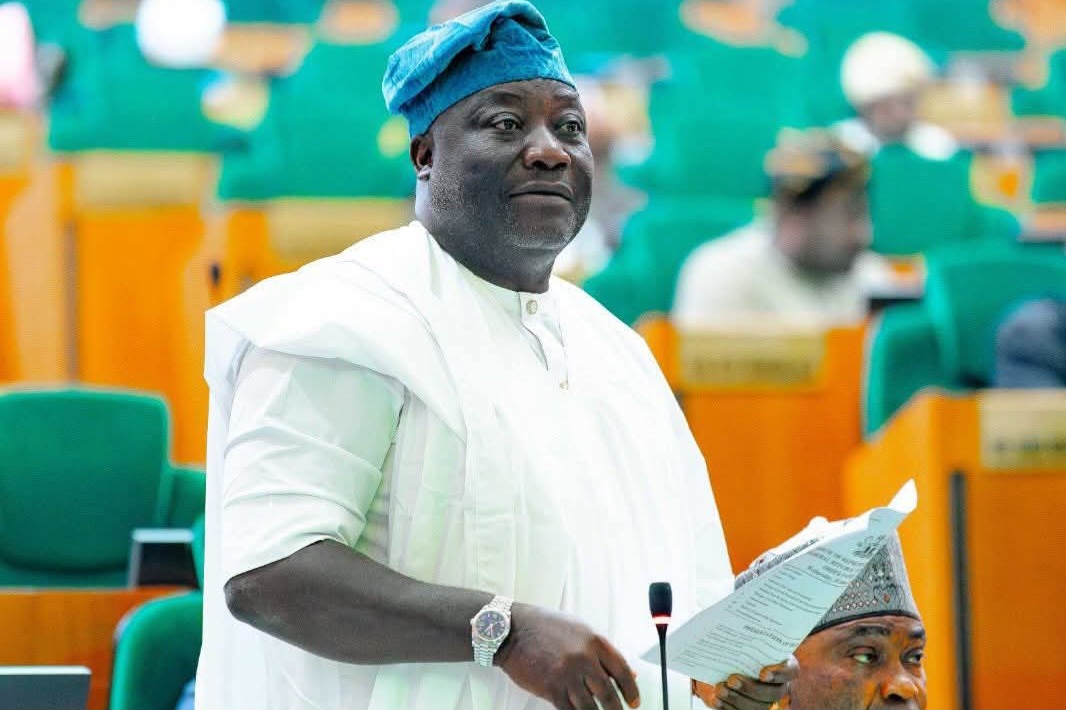

By Korrectnews Editorial Desk
Public office comes with scrutiny, criticism and accountability. Indeed, no elected representative should be shielded from questions about performance, promises or the use of public resources. However, political criticism must be anchored in facts, consistency and an honest understanding of the responsibilities attached to each public office.
Recent social media publications attributed to Olaoye Felix have raised questions about the representation of Hon. Tajudeen Abisodun Kareem Were, the lawmaker representing Saki West, Saki East and Atisbo Federal Constituency at the House of Representatives.
Among the issues raised are the claim that the lawmaker has done little beyond providing solar infrastructure to Ofiki and the argument that residents, particularly members of the Igbo community, should not support his political aspirations.
These claims deserve a response grounded in verifiable records rather than political emotions.
The central question should not be whether Hon. Were is beyond criticism. He is not. The question is whether a fair assessment of his representation can reasonably be reduced to one intervention while overlooking his legislative activities, empowerment programmes, infrastructure facilitation and constituency engagements.
THE OFIKI ROAD QUESTION: UNDERSTANDING GOVERNMENTAL RESPONSIBILITY
One of the issues requiring clarification is the deteriorating road connecting communities around Ofiki.
Road construction and maintenance in Nigeria are divided among the three tiers of government. Federal highways fall under the Federal Ministry of Works, state roads are the responsibility of the respective state governments, while local roads fall under local government authorities.
The Oyo State Government’s official Ministry of Works and Transport identifies the planning, design, construction and management of state roads as responsibilities of its Highways Department.
Consequently, where a road is classified as a state road, the state government bears the primary responsibility for its construction and rehabilitation. A federal legislator can advocate, lobby, facilitate intervention or draw the attention of the relevant authorities to its condition, but should not automatically be held responsible for executing every road project within the constituency.
This distinction is important.
A report published by InsideOyo on September 20, 2024, concerning the commissioning of the Grade A Customary Court in Ofiki, documented the traditional ruler’s appeal to Governor Seyi Makinde to rehabilitate the approximately 15-kilometre Owo–Ofiki–Irawo road.
The report specifically identified the Governor as the recipient of the appeal concerning the road.
This is a relevant historical reference when discussing the respective responsibilities of government authorities. It does not, by itself, establish the legal classification of every section of the road, which should be confirmed through the appropriate road register.
Criticism should therefore be directed at the appropriate authority, while the federal representative should equally be encouraged to continue advocating for the community.
Sources: Oyo State Government, Ministry of Works and Transport; InsideOyo, September 20, 2024.
BEYOND OFIKI: A RECORD OF LEGISLATIVE AND CONSTITUENCY ACTIVITIES
A comprehensive assessment of Hon. Were’s representation must examine the activities documented across the three local government areas.
1. Federal Medical Centre for Saki: A Significant Legislative Initiative
One of the most consequential legislative initiatives associated with Hon. Were is the bill seeking to establish a Federal Medical Centre in Saki.
The proposal, identified as HB.1356, seeks to amend the Federal Medical Centres Act to establish a Federal Medical Centre in Saki, Oyo State, for tertiary healthcare services and medical education.
The House of Representatives’ plenary proceedings of October 30, 2024, record the bill’s successful second reading and referral to the Committee on Health Institutions.
On February 18, 2025, the committee’s report was presented to the House.
The bill subsequently appeared in the House’s July 23, 2025 proceedings for consideration and third reading, where the proceedings recorded its passage.
This is a substantial legislative development for Saki and the wider Oke-Ogun region. The establishment of such an institution would potentially improve access to specialised healthcare, reduce the burden of travelling long distances for tertiary medical services and create employment opportunities.
It is important, however, to distinguish parliamentary passage from final enactment and implementation.
2. Agricultural Support: Distribution of 700 Bags of Fertiliser
On August 20, 2024, ITV News Online reported that Hon. Were distributed 700 bags of fertiliser to farmers drawn from Saki West, Saki East and Atisbo.
The intervention was intended to support agricultural production, reduce the financial burden on rural farmers and contribute to food sufficiency.
For a constituency where agriculture remains an important source of livelihood, access to farm inputs is a relevant economic intervention.
3. Women Empowerment Through Agro-Processing Equipment
In another intervention, more than 35 women across the three local government areas received agro-processing equipment, including universal ovens and dryers.
The programme was designed to support women involved in food processing and small-scale enterprises.
Access to processing equipment can improve production capacity, product quality and business opportunities, particularly for women who operate within the informal agricultural economy.
4. Youth Empowerment Through Fish Farming
In October 2025, Korrectnews reported that more than 100 young people across the constituency benefited from a five-day fish farming empowerment programme.
The beneficiaries received practical aquaculture training and equipment, including fish scales, modern ponds, fishing nets, fingerlings and plumbing materials.
This intervention went beyond distributing materials by combining practical training with productive assets.
The broader objective was to encourage self-employment, promote aquaculture and create opportunities for young people to participate in the agricultural value chain.
5. Road Infrastructure: Tiwadayo/Challenge Project
On October 6, 2024, Korrectnews reported the flag-off of the Tiwadayo/Challenge road construction project in Saki.
The reported project specification included approximately 270 metres of interlocking pavement.
The development demonstrates why constituency infrastructure interventions should be assessed individually rather than assuming that every road project within the constituency must be executed by the same tier of government.
These activities are documented in reports published by ITV News Online, InsideOyo and Korrectnews.
LEGISLATIVE RESPONSIBILITY AT THE NATIONAL LEVEL
Beyond constituency interventions, Hon. Were has also held significant committee responsibilities in the House of Representatives.
He previously served as Chairman of the House Committee on Culture and Tourism before being appointed Chairman of the House Committee on Aviation Technology in February 2025 by Speaker Rt. Hon. Abbas Tajudeen.
His committee responsibilities place him within important areas of national policy, institutional oversight and legislative development.
In May 2025, the Nigerian College of Aviation Technology, Zaria, documented an oversight visit led by Hon. Tajudeen Kareem Abisodun, Chairman of the House Committee on Aviation Technology.
The engagement involved discussions on the institution’s strategic role in producing aviation professionals and the need for improved institutional funding.
These are identifiable parliamentary and institutional activities that form part of the public record.
POLITICAL DISAGREEMENT MUST NOT BECOME ETHNIC EXCLUSION
Perhaps the most troubling dimension of the controversy is the reported appeal to members of the Igbo community not to support Hon. Were.
Political participation should never be determined by ethnicity or religion.
Saki West, Saki East and Atisbo are diverse communities whose residents, regardless of their ancestral origins, religious beliefs or ethnic identities, deserve equal consideration in public affairs.
The Igbo community, like other communities living and doing business across the constituency, contributes to its economic and social life. Its members have every right to participate in political discussions, question their representatives and make independent political decisions.
Equally, no political aspirant or public officeholder should be judged solely by ethnic identity.
If there are shortcomings in Hon. Were’s representation, they should be identified and debated with evidence. If there are achievements, they should also be examined objectively.
It is entirely legitimate to ask why a particular road has not been rehabilitated, why a promised project remains incomplete or why a community has not received a particular intervention.
What is not constructive is turning these questions into a basis for ethnic division.
The constituency belongs to everyone who calls it home.
ACCOUNTABILITY MUST BE CONSISTENT
There is also a need for consistency in public criticism.
If a road is the responsibility of the state government, that responsibility should be acknowledged regardless of political affiliation. If a federal representative has failed to pursue an issue within his legislative mandate, he should equally be asked to explain.
Public accountability cannot operate selectively.
Hon. Were should remain answerable for his legislative record, constituency projects, budgetary interventions and promises to the people. He should also be encouraged to publish more comprehensive project information, including locations, costs, funding sources, implementation status and beneficiary records.
Similarly, anyone making allegations against him should be prepared to provide verifiable evidence.
Social media is a legitimate platform for political expression, but repetition does not establish the truth of an allegation.
THE CONVERSATION OKE-OGUN DESERVES
Ultimately, the people of Saki West, Saki East and Atisbo deserve a more substantive conversation about representation.
They deserve discussions about healthcare, education, electricity, agriculture, employment, road infrastructure, security and economic opportunities.
They deserve representatives who listen, stakeholders who demand accountability and commentators who investigate before drawing conclusions.
Hon. Were is not above scrutiny, and no amount of constituency intervention should exempt him from public accountability. However, neither should his record be reduced to a single project or dismissed through claims that have not been tested against available evidence.
The appropriate standard is simple: examine the records, verify the claims, identify the responsibilities and allow citizens to make their own informed assessments.
Oke-Ogun needs constructive political engagement, not ethnic antagonism. It needs evidence-based criticism, not selective narratives. Above all, it needs a political culture in which every resident, irrespective of origin or religion, has an equal voice in determining the future of the community.
The facts should lead the conversation. Not ethnicity. Not political sentiment. Not social media noise.
KORRECTNEWS