
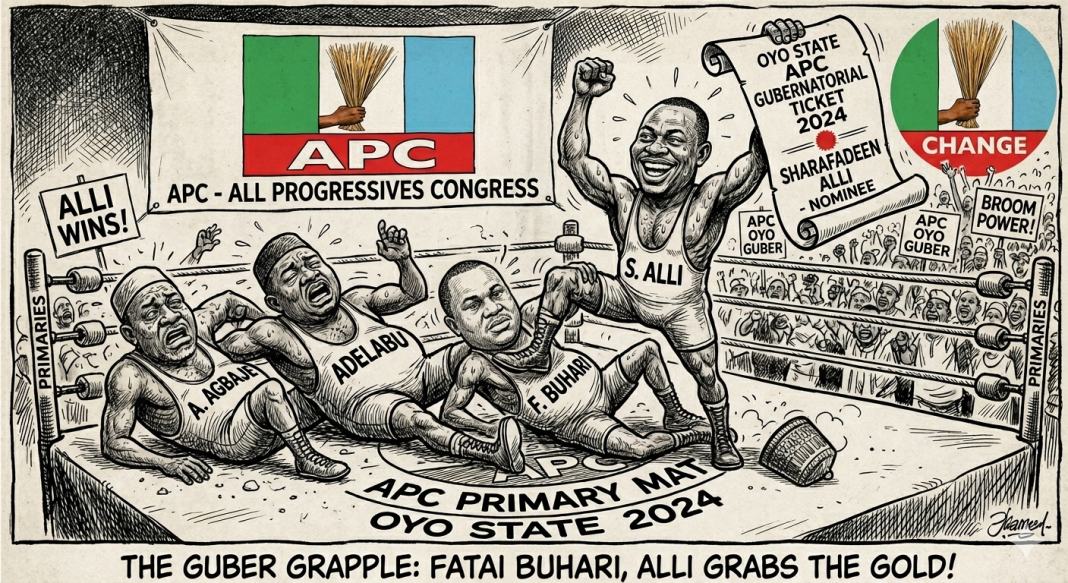

There is a familiar pattern playing out again in Oyo APC politics, and many are watching it with a sense of déjà vu rather than surprise.
What is happening around the current direct primary discussions in the party has reopened old wounds, old alliances, and old grievances that never really healed after 2023.
The complaints of imposition are not new. They are part of a recurring political conversation in Oyo APC, especially when the stakes are high and internal consensus is weak. The direct primary process, which is meant to deepen internal democracy, is again being interpreted by many stakeholders through the lens of loyalty battles and power alignment rather than pure party participation.
The 2023 Shadow Still Lingers
The 2023 elections remain a reference point.
The governorship ticket that produced Teslim Folarin and the senatorial emergence of Fatai Buhari in Oyo North were widely described within party circles as outcomes of intense internal power negotiation.
Supporters of the “Jagba politics” narrative argue that the process reflected more of strategic consolidation than open competition. Whether one agrees with that framing or not, what is clear is that the aftermath left visible political fractures across zones and camps.
One moment that still sits in the political memory of Oke-Ogun was at the OYSADEP complex in Saki during the buildup. I recall the emotional atmosphere around Shina Peller, whose reaction reflected the weight of disappointment many felt at the time. His now-famous lament — “Ile Oke-Ogun ma da” — became more than a statement. It became a symbol of perceived marginalisation within the internal contest.
Defections and Political Realignments
After the primaries and general elections, the ripple effects were immediate.
Figures like Adebayo Adelabu eventually moved out of the APC structure at some point in the political cycle, aligning elsewhere in response to shifting political realities. Others recalibrated, returned, or repositioned.
In different parts of Oyo politics, there were also cases of local power shifts where candidates who felt sidelined either exited or realigned with opposition platforms, including Labour Party and Accord.
These movements were not just personal decisions. They reflected a deeper question: how do political actors interpret fairness within party structures when outcomes appear predictable?
The Present Cycle: 2027 Conversations Already Beginning
Now, ahead of 2027, similar patterns are being discussed again.
Names are already circulating in political conversations, and internal speculation is already shaping expectations around who may emerge stronger in future primaries. Some groups are reading early signals as a return of familiar power blocs, while others argue that nothing is settled until delegates speak.
But the concern remains consistent: allegations of imposition and “arranged outcomes” are again dominating conversations in some quarters.
The Real Issue: Politics of Memory
Oyo APC’s internal politics is increasingly shaped by memory — who lost in 2023, who benefited, who defected, and who returned.
That is why today’s complaints sound familiar. The same actors who once celebrated victory are now accused of engineering exclusion, while those who once felt excluded are now repositioning for relevance.
It raises an uncomfortable but honest question: is Oyo politics truly about ideology and party structure, or about rotational advantage within elite blocs?
My View: No Permanent Victims, No Permanent Winners
The lesson from 2023 and the unfolding dynamics toward 2027 is simple.
In politics, alliances shift faster than narratives. Those who feel sidelined today may become power brokers tomorrow. Those who feel dominant today may become negotiators tomorrow.
That is why the idea of permanent political victimhood does not always hold in practice.
Every key actor in Oyo APC has, at one point or another, experienced either triumph or setback. The same system that produces winners also produces disappointments. And often, roles reverse over time.
Final Thought
What many call “imposition” is, in many cases, the outcome of internal party mathematics, negotiation, and power balance — however uncomfortable that may be.
But if Oyo APC must move forward stronger, it may need to confront one recurring issue: rebuilding trust in its internal processes so that participation feels less like a closed game and more like a genuine contest.
Because in the end, politics rarely forgets. It only rotates influence.
And in Oyo politics, the question is never just who wins — but who remembers, and for how long?